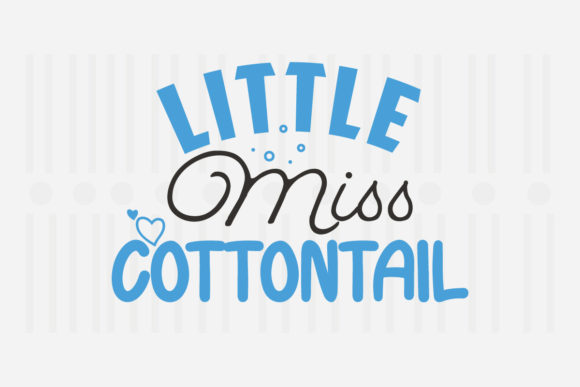
Little Miss Cottontail Easter SVG Review
As a designer who spends half my day staring at stitch charts and the other half worrying about whether a client’s font choice will actually read clearly on a curved hat, I approach every new file with a healthy dose of skepticism. We have all been burned by designs that look adorable in a digital preview but turn into a tangled mess of thread once they hit the hoop. That is why I take the time to evaluate assets like Little Miss Cottontail, Easter SVG not just for their aesthetic appeal, but for their practical viability in a real-world production environment.
This particular design falls squarely into the Crafts and Graphics categories, which immediately signals its intended versatility. The title suggests a playful, character-driven motif—likely featuring a bunny or rabbit theme tied to the Easter holiday. For those of us running small shops on Etsy or managing boutique inventory, the question is never just "Is it cute?" but rather, "Will this sell?" and "Can I produce this consistently without losing my mind?"
First Impressions and Visual Personality
When you first load Little Miss Cottontail, Easter SVG into your digitizing software or vector editor, the immediate takeaway is its clean, graphic nature. Unlike complex pictorial designs that rely on thousands of tiny color changes to create depth, this design appears to lean into bold shapes and clear lines. This is a significant advantage for embroidery. In the world of machine embroidery, less is often more. A design that relies on strong silhouettes tends to hold up better over time, resisting the fraying and distortion that can plague overly intricate fills.
The mood created by the design is undeniably cheerful and seasonal. It taps into the nostalgic, soft aesthetics that dominate the spring market. Whether it features a simple quote, a stylized bunny, or a combination of both, the visual personality feels approachable. It does not try too hard. For an Etsy seller or a maker of personalized gifts, this kind of understated charm is often more valuable than a loud, chaotic design because it appeals to a broader demographic, from young parents looking for nursery decor to older crafters making holiday treats.
Real-World Application: From Screen to Stitch
Let’s imagine a specific scenario. You are preparing a batch of custom embroidered tote bags for a local spring craft fair. You want something that screams "Easter" but isn't so childish that adults won't carry it around. You pull up Little Miss Cottontail, Easter SVG. Because the source files include EPS and SVG formats, you have the flexibility to scale the design to fit perfectly on the center chest of a canvas tote or as a smaller accent on the side pocket.
In this context, the design shines. Tote bags are durable, flat surfaces that forgive minor stitching imperfections. The clean lines of the SVG translate well into satin stitches for outlines and fill stitches for solid areas. If you are using this for custom apparel like sweatshirts or t-shirts, the design’s simplicity ensures it remains legible even after multiple washes. Customers trust products that look professional out of the box. A clean, well-executed stitch job on a hoodie tells the buyer that attention was paid to detail, increasing the perceived value of the item.
Furthermore, the description notes that the design is "100 Color Changeable." This is a critical feature for modern makers. It means you are not locked into a specific palette. If your target audience prefers pastel pinks and blues, you can adjust the thread colors accordingly. If you are targeting a more gender-neutral market, switching to sage greens and creams is effortless. This adaptability allows you to test different markets without needing to purchase entirely new design files.
Where Caution Is Required
However, no design is perfect for every surface. While Little Miss Cottontail, Easter SVG works beautifully on flat fabrics, there are situations where you need to exercise judgment. If you plan to use this on a structured baseball cap, the curvature of the front panel might distort fine details. Always check the hoop size compatibility before committing to a run. If the design includes tiny lettering or very thin decorative accents, these elements may get lost in the fabric texture or become difficult to stabilize properly.
Additionally, consider the fabric type. On stretchy knits, such as those used for baby onesies or athletic wear, dense stitch areas can cause puckering. If the design utilizes heavy fill stitches, you must ensure you are using the correct stabilizer—likely a cut-away stabilizer for stretch fabrics—to maintain integrity. On textured fabrics like bouclé or thick wool, small details may disappear entirely. In these cases, it is wise to test the design on scrap fabric first to see how the thread interacts with the weave.
Practical Notes for the Embroidery Designer
Before you rush to print mockups or start sewing, here are a few practical steps to ensure your embroidery project succeeds:
- Test on Scrap Fabric: Never assume a design will stitch out perfectly on your final material. Run a test on the exact fabric and stabilizer combination you plan to use. This helps you identify potential issues with thread tension or density.
- Check Contrast: Even though the file is color changeable, ensure that your chosen thread colors provide enough contrast against the background fabric. Low contrast can make the design look muddy and unprofessional.
- Review Stitch Density: Look closely at the digitization. Are there areas where the stitches are too close together, risking needle breakage or fabric distortion? Or are there gaps that leave the fabric showing through? A balanced density ensures durability and a clean finish.
- Verify Licensing: Since you are likely using this for a craft business or commercial purposes, double-check the license terms included with the download. Some SVG files are for personal use only, while others allow for unlimited commercial sales of finished goods. Clarity here protects your small shop from legal headaches.
- Black and White Mockups: View the design in black and white to check its composition. If the shape holds up without color, it will likely embroider well. This technique helps you focus on the form and balance of the design assets.
Final Verdict on Value and Appeal
Ultimately, Little Miss Cottontail, Easter SVG offers a solid foundation for seasonal product lines. Its strength lies in its simplicity and adaptability. It is not trying to be a photorealistic masterpiece; instead, it serves as a reliable, charming graphic that enhances everyday items. For digital product sellers, the inclusion of high-resolution EPS and SVG files adds value, allowing buyers to use the asset beyond just embroidery—in sublimation printing, vinyl cutting, or paper crafting.
For the handmade entrepreneur, this design fits seamlessly into the current trend of personalized, meaningful gifting. Whether it ends up on a kitchen towel for a housewarming gift, a pillow cover for a nursery, or a patch on a denim jacket, the design carries a warm, festive energy that resonates with customers. It supports brand consistency by offering a recognizable, repeatable style that can become part of your shop’s signature look.
While it requires standard precautions regarding fabric choice and stabilization, Little Miss Cottontail, Easter SVG is a versatile tool in any designer’s arsenal. It balances aesthetic appeal with production practicality, making it a smart choice for anyone looking to capitalize on the spring season without sacrificing quality or professionalism.